

Your solar company bought a CRM. You paid for it. You trained your team on it. You probably even ran a meeting about why everyone needs to use it.
Three months later, half your reps have stopped logging anything. Your pipeline data is unreliable. Deals are slipping through the cracks. And when you ask your team what went wrong, the answer is always the same: “It’s too much work.”
This is not a people problem. This is a CRM problem.
Most CRMs on the market were built for generic sales teams at tech companies or enterprise B2B businesses. They were not built for a solar installer managing door-to-door reps, field surveys, installation schedules, and partner referrals all at once.
Here are the exact reasons CRM fails most solar companies — and what a solar-specific CRM needs to do differently.
1. Data Entry Is Killing Your Sales Team’s Motivation
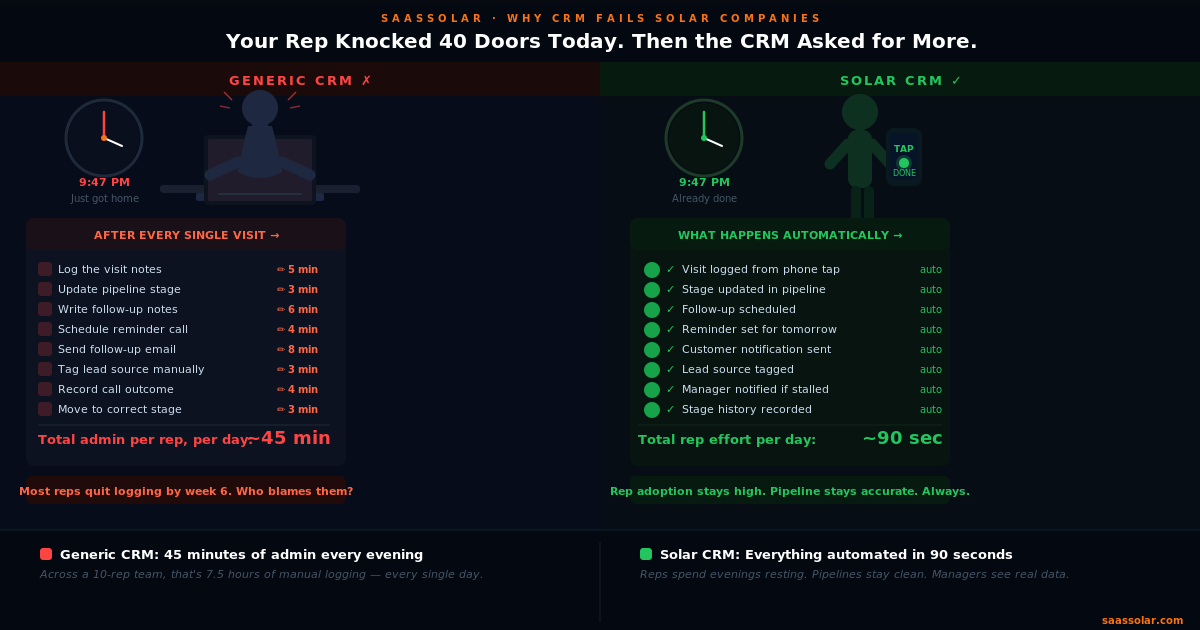
Ask any solar sales rep what they hate most about their CRM, and the answer is immediate: data entry.
After a full day of knocking doors, running roof assessments, sitting at kitchen tables selling solar systems — the last thing a rep wants to do is open a laptop and type notes into a CRM.
Generic CRMs are built around the assumption that a salesperson sits at a desk. They require manual note entry, manual stage updates, manual activity logging. Every interaction needs to be typed in. Every call needs to be recorded manually. Every follow-up needs to be scheduled by hand.
In solar sales, this is a dealbreaker.
The right solar CRM should reduce data entry — not increase it. That means automatic pipeline progression, one-tap status updates in the field, and automation that moves leads forward without a rep having to manually touch every record.
When your CRM does the heavy lifting, your reps actually use it.
2. No Solar-Specific Workflows Means Every Deal Is Pushed Manually
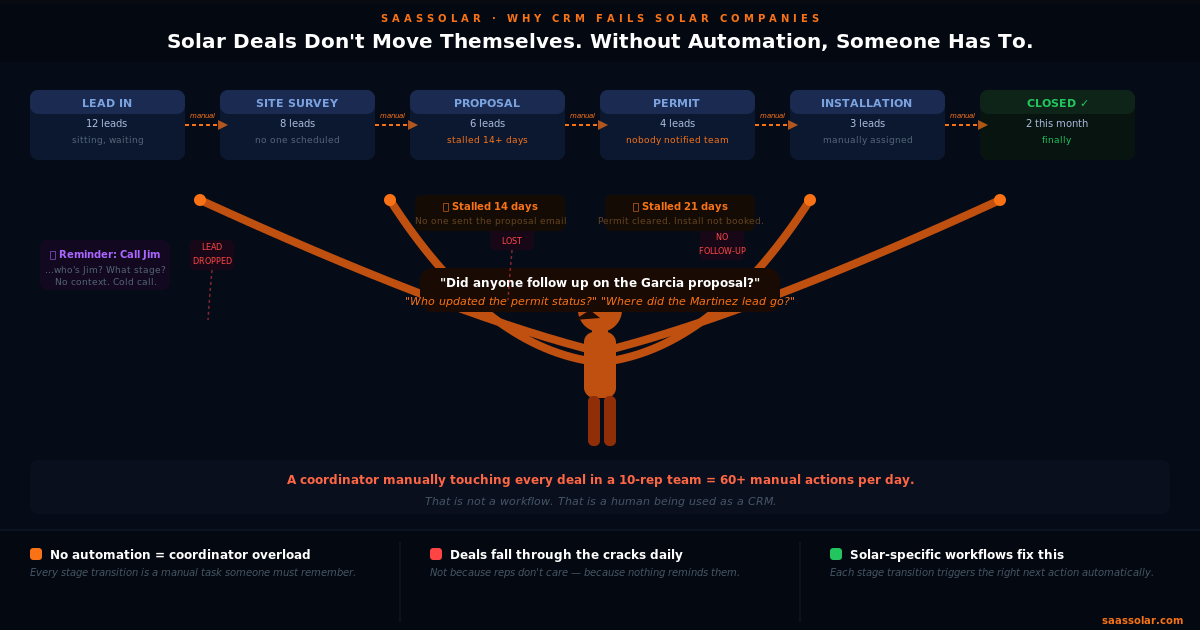
A CRM without solar-specific workflows is an expensive spreadsheet.
Solar sales has a complex journey. A lead goes from initial contact to site survey to proposal to permit to installation to handoff. At every single stage, there are tasks, notifications, assignments, and follow-ups that need to happen. In most solar companies, a manager or coordinator is manually pushing deals through each stage.
That is not a scalable process.
The right solar CRM should have built-in workflow automation designed around the solar pipeline — not adapted from some generic sales process. When a site survey is booked, the right things happen automatically. When a proposal is sent, the follow-up fires without anyone scheduling it. When a permit clears, the next team is notified without a single manual message.
No dropped handoffs. No deals stuck in limbo because someone forgot to update a field.
Workflows are what separates a real solar CRM from a record-keeping tool.
3. Your Reps Are Selling Without Any Coaching
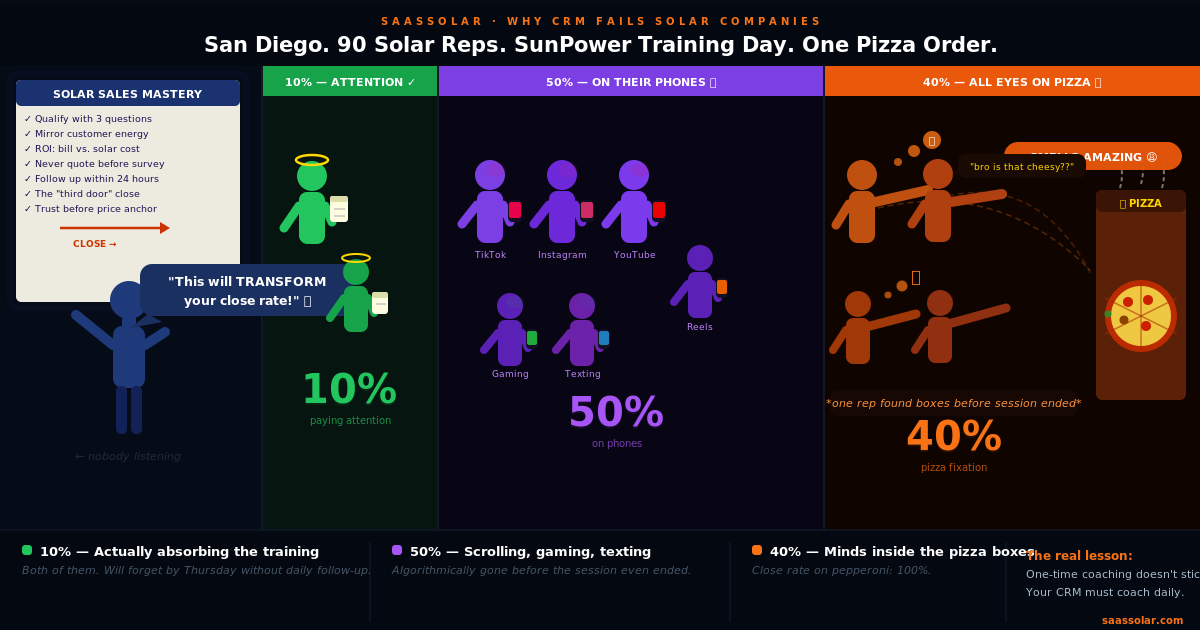
I was in San Diego once, visiting a solar company that had about 90 door knockers on their team. The owner had arranged a proper coaching session — brought in trainers from SunPower, cleared the schedule, got everyone in the same room. He even ordered pizza.
Here is what I remember most about that afternoon: the smell of that pizza was absolutely everywhere. And most of those 90 reps were a lot more focused on when the boxes were going to open than on anything happening at the front of the room.
The owner had done everything right — the investment, the trainers, the effort. But you cannot coach 90 field reps into lasting behavior change with a one-time session and a box of pepperoni.
That is not how people learn. And that is not how the best sales habits stick.
The best sales teams in the world do not rely on quarterly training days. They build coaching into the daily flow — constant, small, contextual nudges that happen at the right moment, with the right information, right when a rep needs it.
Most CRMs offer zero coaching capability. They simply record what happened after the deal is already won or lost.
Solar teams need a system that helps reps in the moment — not just tracks results after the fact. Something that surfaces patterns, flags stalled leads, and helps managers coach from data rather than gut feel.
The companies that figure this out first will pull ahead fast. A pizza party is not a coaching strategy.
4. Reminders Without Context Are Worthless
“Call John at 3pm on Thursday.”
That reminder means nothing without context. What stage is John at? Did he express hesitation about pricing? Was his wife going to review the proposal? How long has he been in the pipeline?
A reminder without context sends a rep into a call cold — even when they have history with the customer.
Smart reminders should carry full context. They should surface the last interaction, the customer’s current stage, their hesitation points, and what the right next action is. And they should trigger automatically based on where a lead is in the pipeline — not just on whatever a rep remembered to schedule.
5. Nobody Tells the Customer the Rep Is Coming
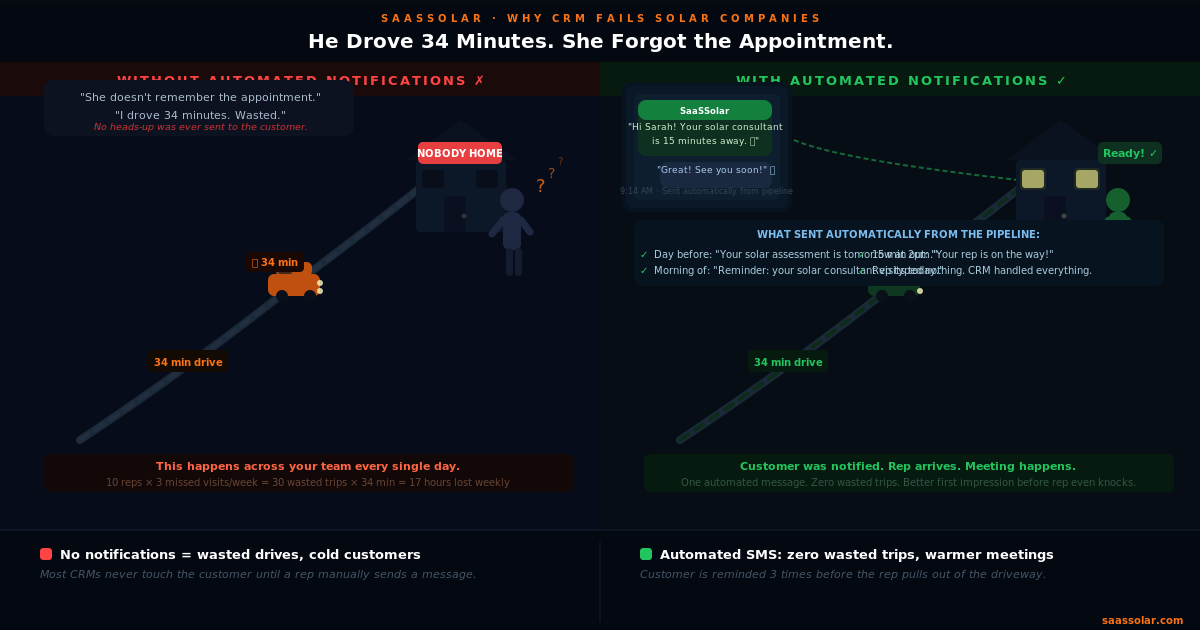
This is one of the most overlooked failures in solar field sales.
A rep drives 30 minutes to a customer’s house. The customer is not home. Or they forgot. Or they thought the appointment was a different day. The rep drives back. The lead goes cold.
This happens every day across solar sales teams because most CRMs are not built to communicate with the customer at all.
The right solar CRM should send the customer an automatic notification when an appointment is confirmed, a reminder the day before, and a heads-up when the rep is on the way. Automatically. Without the rep typing anything.
“Hi Sarah — your solar consultant is 15 minutes away for your assessment.”
That one message, sent automatically from the pipeline, eliminates a large percentage of wasted field visits and improves the customer experience before the rep even walks in the door.
6. No SMS Means You Are Losing on Response Time
Solar buyers respond to SMS faster than any other channel.
Email inboxes are cluttered. Phone calls go to voicemail. But a text message gets opened within minutes.
Generic CRMs were designed for B2B enterprise sales teams where email is the primary channel. They do not have SMS built in — or they offer it as an expensive third-party add-on that takes weeks to configure.
For solar sales — residential or commercial — SMS is not optional. It is the primary communication channel for fast-moving leads, appointment confirmations, follow-up nudges, and customer notifications.
If your CRM cannot send a text directly from the pipeline, you are already behind.
7. Commercial Solar Teams Are Selling Without Signals
Residential solar is about homeowners. Commercial solar is about businesses. And businesses have signals.
A company that just received investment is expanding. A business announcing a new facility is thinking about infrastructure. A company hiring sustainability roles is actively pursuing ESG goals.
These are buying signals. And if nothing in your process is surfacing them, your commercial solar team is cold calling companies with no idea whether they are even in the market.
Commercial solar is not just about having a good pitch. It is about reaching the right business at the right moment. Most solar teams are missing that moment completely — not because they lack effort, but because nothing in their CRM is helping them find it.
8. In Commercial Solar, You Miss the Window or You Lose the Deal
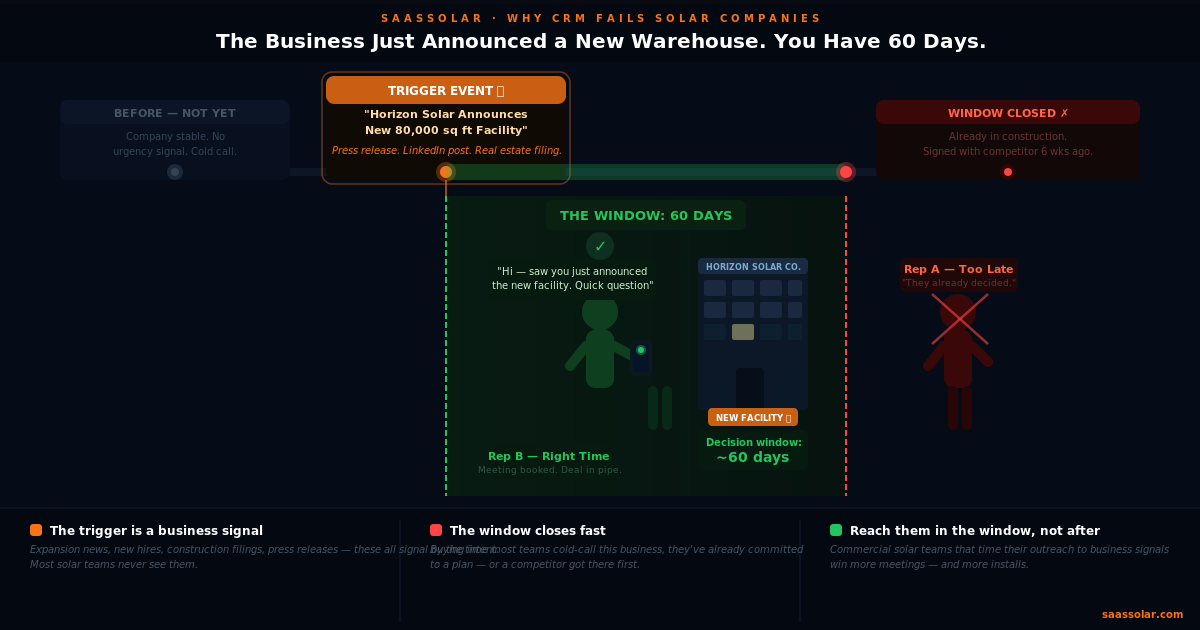
In commercial solar, timing is everything. The same company that is uninterested in January can become a hot lead in March because of a single event.
Their energy bill went public. They announced a new warehouse. They hired a new CFO focused on cost reduction. A competitor just went solar and the press covered it.
These are windows. Most solar companies miss them entirely. Not because they were not good enough — but because nothing in their system was watching.
The solar companies winning in commercial right now are the ones reaching out at exactly the right moment.
What a Real Solar CRM Needs to Do
After all of this, the picture is clear. A CRM that actually works for solar companies needs to:
- Eliminate data entry so reps spend time selling, not logging
- Run solar-specific workflows that push deals forward without manual effort
- Give reps the context they need before every call and field visit
- Notify customers automatically when appointments are coming and when reps are on the way
- Support SMS natively as a first-class communication channel
- Help commercial teams reach the right businesses at the right moment
This is not what most generic CRMs offer. Most were built for a completely different kind of sales team.
SaaSSolar: Built for How Solar Companies Actually Sell
SaaSSolar is a CRM built exclusively for the solar industry. Not adapted from a generic platform. Not bolted together from third-party tools. Built from the ground up for solar installers, solar sales teams, and solar businesses that want a system that works the way they do.
From lead to installation to customer handoff, SaaSSolar manages the full solar journey — with automation, smart workflows, solar-specific pipeline stages, partner portals, customer portals, and a feature set designed around how solar companies actually close deals.
If your current CRM is slowing your team down, it is not your team’s fault. It is the wrong tool for the job.
Book a demo of SaaSSolar and see what a solar-specific CRM actually looks like.
Frequently Asked Questions
Why do solar companies struggle with CRM adoption?
Most CRMs require too much manual data entry and are not designed for field-based solar sales. Reps abandon them because the tool creates more work than it removes. A solar-specific CRM with built-in automation dramatically improves adoption rates.
What should a CRM for solar companies include?
A solar CRM should include solar pipeline management, workflow automation, SMS communication, automatic customer notifications, document handling, partner portals, and a feature set designed around how solar companies sell — not how generic B2B sales teams sell.
Can a solar CRM send SMS to customers?
Yes — the right solar CRM should support SMS directly from the pipeline so reps can communicate with customers, send appointment reminders, and notify customers when they are on the way — without switching tools.
What is the biggest reason solar companies stop using their CRM?
Data entry. Reps in the field do not want to spend time logging notes, updating stages, and scheduling follow-ups manually after every interaction. A solar CRM should automate these tasks so the pipeline stays accurate without rep effort.
Is a generic CRM good enough for a solar company?
Generic CRMs can work for basic contact management, but they lack the solar-specific pipeline stages, workflows, and communication tools that solar companies need. Most solar teams outgrow generic CRMs quickly and end up with messy data and low rep adoption.