

Finding the best CRM for solar companies in the USA is harder than it looks. Type “solar CRM” into Google and you find review sites comparing Salesforce, HubSpot, and Zoho — tools built for generic sales teams. But running a solar company is nothing like running a generic sales operation.
Solar companies manage leads from door-to-door canvassing, web forms, partner networks, and referrals — all at the same time. They run site surveys, build custom proposals, arrange financing, handle permits, schedule installation crews, track project milestones, and then support customers through the post-installation phase. That is five distinct workflows. Most CRMs only help with one.
This guide is written for US solar companies — installers, residential solar businesses, EPC companies, and door-to-door sales organizations — who need a CRM that matches how solar actually works.
What Solar Companies Need From a CRM
A solar CRM needs to do more than manage a sales pipeline. The best CRM for solar companies in the USA should cover the entire customer journey — from the first lead to the completed installation and beyond.
Here is what that actually looks like on the ground:
- Lead management from multiple sources — door-to-door reps, web forms, referrals, and partner submissions all need to flow into one pipeline, not five separate spreadsheets.
- Solar-specific pipeline stages — your pipeline should have stages for site survey, proposal, financing approval, contract signing, permitting, installation, and customer handoff. Generic “Lead → Proposal → Closed” does not reflect the solar process.
- Installation and project tracking — closing a deal does not end the job. You need to track permits, crew scheduling, milestones, and PTO dates inside the same system.
- Customer and partner portals — customers want to see their project status without calling your office. Partners and dealers need their own access to submit and track leads.
- Role-based access — a door-to-door rep, an office admin, and a project manager should each see only what they need to see.
The Solar Workflow No Generic CRM Covers End to End
Most generic CRMs treat “closed” as the finish line. For solar companies, closing a deal is the starting gun. The operational complexity begins after the contract is signed — and that is where most solar businesses have the biggest data gaps.
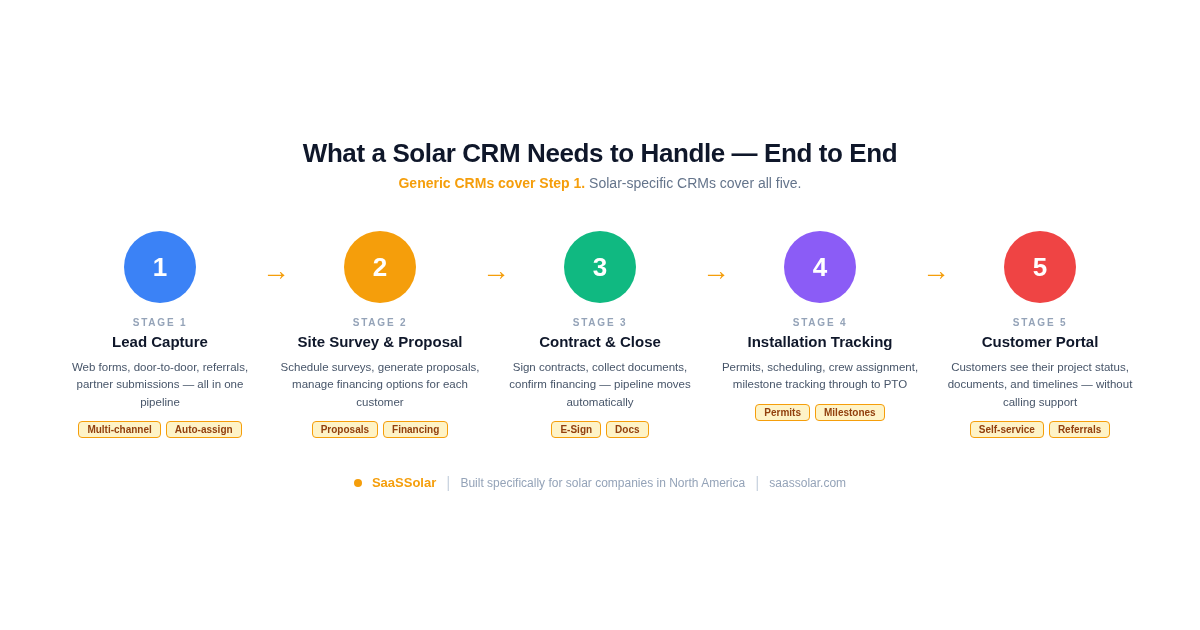
A residential solar installation involves permit applications, utility interconnection approvals, equipment delivery, crew scheduling, inspection scheduling, and finally PTO (Permission to Operate). A commercial project can take 6 to 18 months with multiple stakeholders, milestone payments, and site-specific complications.
If your CRM does not track all of this in one place, your team is managing the gap with spreadsheets, WhatsApp groups, and sticky notes — and leads and projects fall through the cracks.
Solar CRM vs Generic CRM: The Real Difference
Generic CRMs like Salesforce, HubSpot, and Zoho are powerful tools built for flexible deployment across many industries. They can be configured for solar — but that configuration takes months, requires expensive developers, and still does not give you features that are native to a solar-specific platform.
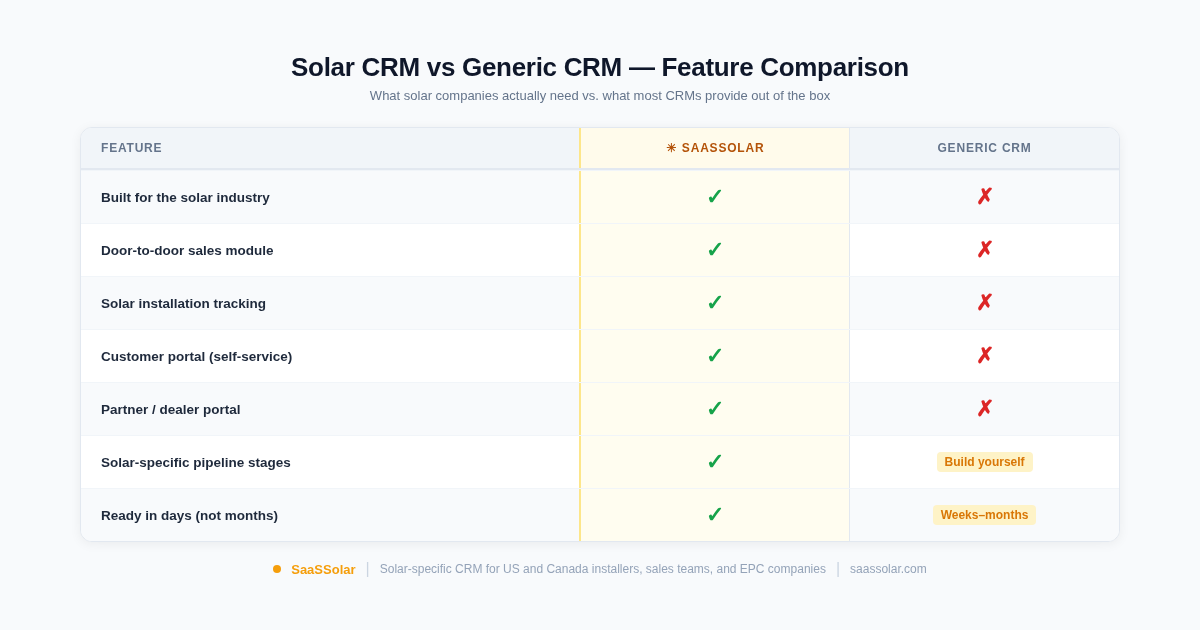
The difference is not just features. It is time to value. A solar-specific CRM works the way your business works from day one. A generic CRM works the way your business works only after months of configuration — and that configuration has to be maintained as your business changes.
What to Look for When Choosing a Solar CRM in 2026
Not every solar CRM is built equally. Here are the features that separate a tool worth using from one that creates more problems than it solves.
1. Solar-Specific Pipeline Stages Built In
Your pipeline stages should reflect the actual stages of a solar sale and installation — not a generic model that ignores site surveys, financing, permitting, and installation. Look for a CRM where these stages are built in, not something you configure manually from scratch.
2. Door-to-Door Sales Support
If your team does any door-to-door or canvassing work, you need a CRM with a mobile-ready D2D module. Reps need to capture leads, log notes, and check territory assignments from the field — not wait until they are back at the office.
3. Installation Tracking Beyond the Sale
Once a contract is signed, the CRM should handle what comes next: permit tracking, equipment ordering, installation scheduling, milestone completion, and inspection booking. If these activities live outside your CRM, you have a data gap that will eventually cost you a customer or a deal.
4. Customer and Partner Portals
The best solar CRMs give customers a self-service portal where they can check project status, view documents, and ask questions — without calling your support team. Partner portals let dealers and referral partners submit leads and track activity without requiring your team to manually update them on every deal.
5. Role-Based Access for Every Team Member
A solar company’s team includes sales reps, installers, admins, project managers, and executives — each with different data needs. A good solar CRM gives each role exactly the access they need and nothing they do not.
6. Document and File Management
Solar deals generate a lot of paperwork — site assessments, proposals, financing agreements, permits, utility applications, inspection reports. A CRM that stores these documents alongside the customer record saves hours of searching and prevents the classic problem of nobody knowing where the signed contract is.
SaaSSolar: Built Specifically for Solar Companies in North America
SaaSSolar is a CRM built from the ground up for solar companies in the United States and Canada. It is not a generic CRM adapted for solar — it is a platform built specifically around how solar businesses operate.
Built-in capabilities include:
- Solar lead management across all channels — web, door-to-door, referrals, and partner networks
- Solar-specific pipeline stages from first contact through completed installation and customer portal handoff
- Door-to-door sales module for field reps
- Partner portal for dealers and referral partners
- Customer self-service portal — project status, documents, and timelines
- Installation and project tracking from permit application to PTO
- Document storage and management
- Task management and team coordination tools
- Role-based access controls for every team member
- Multi-warehouse inventory management
- Campaign and lead source tracking
SaaSSolar is designed for residential solar companies, commercial solar businesses, EPC companies, solar installers, and door-to-door sales teams across the United States and Canada.
Frequently Asked Questions
What is the best CRM for solar companies in the USA?
The best CRM for a solar company depends on your specific operation, but for most US solar businesses a solar-specific CRM will outperform a generic tool. The main reason: solar-specific CRMs handle the full workflow including installation tracking, permitting, and customer portals — areas that generic CRMs require extensive and expensive customization to cover.
Can I use HubSpot or Salesforce for a solar company?
You can, but with significant trade-offs. Both platforms can be configured for solar, but they were not built for it. Configuration takes time and money, and you will still be missing features that are native to solar-specific platforms — like installation milestone tracking, permit management, and door-to-door sales modules. The total cost of ownership for a properly configured Salesforce or HubSpot instance at a solar company is typically much higher than a purpose-built solar CRM.
What features does a solar CRM need?
A solar CRM should cover: lead management across multiple channels, solar-specific pipeline stages, site survey and proposal tracking, installation and project management, permit tracking, customer portal, partner and dealer portal, role-based access, document management, and campaign tracking. Any CRM missing the installation tracking and customer portal components is really just a sales tool — not a full solar business management platform.
Is there a CRM built specifically for US solar installers?
Yes. SaaSSolar is built specifically for solar companies in North America, with a primary focus on the United States and Canada. The platform is built around the workflows, regulations, and business models of US and Canadian solar installers, EPC companies, and residential and commercial solar businesses.
How is a solar CRM different from a general CRM?
A general CRM handles lead tracking and sales pipeline management. A solar CRM goes further — it covers the post-sale workflow that defines the solar business: permits, installation scheduling, crew management, milestone tracking, utility interconnection, and customer self-service access. It also includes solar-specific lead sources like door-to-door canvassing and partner portals that most general CRMs do not address natively.
Want to see how SaaSSolar handles your solar company’s complete workflow — from first lead to final installation?